
| |
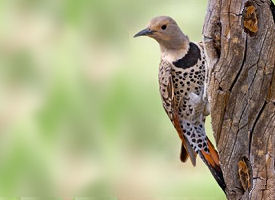
Yellowhammer
(Yellow-shafted Flicker)

It is
generally agreeable to be in the company of
individuals who are naturally animated and
pleasant. For this reason, nothing can be
more gratifying than the society of
Woodpeckers in the forests. To prove this to
you, kind reader, I shall give you a full
account of the habits of the Golden-winged
Woodpecker.
This
species, which is usually called Pique-bois jaune by the
French settlers in Louisiana, and receives the name of
High-holder, Yucker, and Flicker in other parts of the
Union, being seldom or never graced with the epithet
Golden-winged, employed by naturalists, is one of the most
lively of our birds, and is found over the whole of the
United States.
No sooner
has spring called them to the pleasant duty of making love,
as it is called, than their voice, which, by the way, is not
at all disagreeable to the ear of man, is heard from the
tops of high decayed trees, proclaiming with delight the
opening of the welcome season. Their note at this period is
merriment itself, as it imitates a prolonged and jovial
laugh, heard at a considerable distance. Several males
pursue a female, reach her, and, to prove the force and
truth of their love, bow their heads, spread their tail, and
move sidewise, backwards and forwards, performing such
antics, as might induce any one witnessing them, if not of a
most morose temper, to join his laugh to theirs. The female
flies to another tree, where she is closely followed by one,
two, or even half a dozen of these gay suitors, and where
again the same ceremonies are gone through. No fightings
occur, no jealousies seem to exist among these beaux, until
a marked preference is shewn to some individual, when the
rejected proceed in search of another female. In this manner
all the Golden-winged Woodpeckers are soon happily mated.
Each pair immediately proceed to excavate the trunk of a
tree, and finish a hole in it sufficient to contain
themselves and their young. They both work with great
industry and apparent pleasure. Should the male, for
instance, be employed, the female is close to him, and
congratulates him on the removal of every chip which his
bill sends through the air. While he rests, he appears to be
speaking to her on the most tender subjects, and when
fatigued, is at once assisted by her. In this manner, by the
alternate exertions of each, the hole is dug and finished.
They caress each other on the branches, climb about and
around the tree with apparent delight, rattle with their
bill against the tops of the dead branches, chase all their
cousins the Red-heads, defy the Purple Grakles to enter
their nest, feed plentifully on ants, beetles and larvae,
cackling at intervals, and ere two weeks have elapsed, the
female lays either four or six eggs, the whiteness and
transparency of which are doubtless the delight of her
heart. If to raise a numerous progeny may contribute to
happiness, these Woodpeckers are in this respect happy
enough, for they have two broods each season; and as this
might induce you to imagine Woodpeckers extremely abundant
in our country, I may at once tell you that they are so.
Even in
confinement, the Golden-winged Woodpecker never suffers its
naturally lively spirit to droop. It feeds well, and by way
of amusement, will continue to destroy as much furniture in
a day as can well be mended by a different kind of workman
in two. Therefore, kind reader, do not any longer believe
that Woodpeckers are such stupid, forlorn, dejected and
unprovided for beings as they have hitherto been
represented. In fact, I know not one of the species found in
our extensive woods, that does not exhibit quite as much
mirth and gaiety as the present bird. They are serviceable
birds in many points of view, and therefore are seldom shot
at, unless by idlers; their flesh, moreover, not being very
savoury. They have ample range, and wherever they alight,
there is to be found the food to which they at all times
give decided preference.
The flight
of this species is strong and prolonged, being performed in
a straighter manner than that of any other of our
Woodpeckers. They propel themselves by numerous beats of the
wings, with short intervals of sailing, during which they
scarcely fall from the horizontal. Their migrations,
although partial, as many remain even in the middle
districts during the severest winters, are performed under
night, as is known by their note and the whistling of their
wings, which are heard from the ground, although by no means
so distinctly as when they fly from a tree or from the
earth, when suddenly alarmed. When passing from one tree to
another on wing, they also fly in a straight line, until
within a few yards of the spot on which they intend to
alight, when they suddenly raise themselves a few feet, and
fasten themselves to the bark of the trunk by their claws
and tail. If they intend to settle on a branch, which they
as frequently do, they do not previously rise; but in either
case, no sooner has the bird alighted, if it be not pursued
or have suspicions of any object about it, than it
immediately nods its head, and utters its well-known note,
"Flicker." It easily moves sidewise on a small branch,
keeping itself as erect as other birds usually do; but with
equal ease does it climb by leaps along the trunks of trees
or their branches, descend, and move sidewise or spirally,
keeping at all times its head upwards, and its tail pressed
against the bark as a support.
On the
ground, where it frequently alights, it hops with great
ease. This, however, it does merely to pick up a beetle, a
caterpillar, a grain of corn dropt by a squirrel from the
ear in the fields, or to enable it to examine the dead roots
of trees, or the side of a prostrate log, from which it
procures ants and other small insects. It is also fond of
various fruits and berries. Apples, grapes, persimmons and
dogwood berries seem quite agreeable to it, and it does not
neglect the young corn of the farmer's field. Even
poke-berries or huckle-berries answer its purpose at times,
and during winter it is a frequenter of the corn-cribs.
In this
species, as in a few others, there is a singular arrangement
in the colouring of the feathers of the upper part of the
head, which I conceive it necessary for me to state, that it
may enable persons better qualified than myself to decide as
to the reasons of such arrangement. The young of this
species frequently have the whole upper part of the head
tinged with red, which at the approach of winter disappears,
when merely a circular line of that colour is to be observed
on the hind part, becoming of a rich silky vermilion tint.
The Hairy, Downy and Red-cockaded Woodpeckers are subject to
the same extraordinary changes, which, as far as I know,
never reappear at any future period of their lives. I was at
first of opinion that this change appeared only on the head
of the male birds, but on dissection I found it equally
affecting both sexes. I am induced to believe, that, in
consequence of this, many young Woodpeckers of different
species have been described and figured as forming distinct
species themselves. I have shot dozens of young Woodpeckers
in this peculiar state of plumage, which, on being shewn to
other persons, were thought by them to be of different
species from what the birds actually were. This occurrence
is the more worthy of notice, as it is exhibited on all the
species of this genus on the heads of which, when in full
plumage, a very narrow line exists.
Racoons and
Black-snakes are dangerous enemies to this bird. The former
frequently put one of their fore legs into the hole where it
has nestled or retired to rest, and if the hole be not too
deep, draw out the eggs and suck them, and frequently by the
same means secure the bird itself. The Black-snake contents
itself with the eggs or young. Several species of Hawks
attack them on the wing, and as the Woodpeckers generally
escape by making for a hole in the nearest tree, it is
pleasing to see the disappointment of the Hawk, when, as it
has just been on the point of seizing the terrified bird,
the latter dives, as it were, into the hole. Should the
Woodpecker not know of a hole near enough to afford it
security, it alights on a trunk, and moves round it with
such celerity as frequently to enable it to elude its
pursuer.
Their flesh
is esteemed good by many of the sportsmen of the Middle
Districts, and is frequently eaten. Some are now and then
exposed in the markets of New York and Philadelphia; but I
look upon the flesh as very disagreeable, it having a strong
flavour of ants.
The neck of
this species is larger than that of any other with which I
am acquainted, and consequently the skin of this bird is
more easily pulled over the head, which it is difficult to
do in the other species, on account of the slenderness of
their neck, and the great size of the head.
This
species visits the Fur Countries in summer, advancing as far
north as Great Bear Lake, and, according to Dr. RICHARDSON,
resorting in the greatest numbers to the plains of the
Saskatchewan, where it frequents open downs, and feeds on
larva. Mr. TOWNSEND has traced it high on the upper
Missouri, but saw none near the Columbia, where it is
represented by the Red-shafted Woodpecker, which is there as
abundant as the present species is in our Eastern Districts.
I have met with it from Texas to the northern extremity of
Nova Scotia, but saw none in Labrador. The eggs measure an
inch and a twelfth in length, by nearly seven-eighths in
breadth. Mr. T. MACCULLOCH has favoured me with the
following notice respecting this species.
"While
rambling through the woods one afternoon with my brothers, I
observed a considerable quantity of chips, which seemed,
from the freshness of their colour, to have been but
recently detached from the tall decayed stump, at the foot
of which they were laid. A glance at a round hole near the
top of the stump was sufficient to apprize us of their
origin, and a few smart raps upon the trunk brought a
Golden-winged Woodpecker to the aperture, to ascertain the
cause of the disturbance below. Having eyed us for a moment,
he jerked himself out, and flew to the top of a neighbouring
tree, where, uttering a few shrill notes, he was immediately
joined by his mate, and both seemed anxiously to watch all
our movements while we remained near the cradle of their
future progeny. By us the possession of one of these
beautiful birds had long been ardently desired, and we
determined not to permit the present opportunity to pass
unimproved. The situation of the nest was therefore
carefully marked, and we resolved to return when the young
birds should be fully fledged, and secure one at least as
our lawful prize. During the interval the nest was often
visited, and many plans were formed to effect our purpose,
but when the period which we supposed necessary had expired,
we discovered with no little mortification that the stump
was too much decayed to be climbed with safety, and too
insecure to admit of any thing being applied to facilitate
the ascent. To overturn the nest was the only way then by
which we could obtain the object of our wishes. To effect
this all our strength was exerted, so that we soon had the
satisfaction of seeing the stump yield, and eventually give
way with a heavy crash, by which it was broken into many
pieces. Eager to secure our prize, we hastened to the spot,
but conceive our disappointment when, instead of the
full-fledged birds which we expected to obtain, a large
number of naked objects, apparently just out of the shell,
some of them scarcely half the size of others, and all with
their eyes yet unopened, lay scattered upon the ground. This
was a result which we had never anticipated, and
disappointment quickly yielded to strong feelings of
compunction, as we surveyed the poor sightless creatures
writhing their necks and quivering under the severity of the
shock. To repair the mischief, if possible, the fragments of
the nest were speedily gathered and neatly joined, and
having collected the brood for the purpose of replacing it,
we were astonished to find that the nest had contained the
almost incredible number of eighteen young birds, besides
three eggs, which still remained unbroken, notwithstanding
the violence of the fall. For this singular instance of
fecundity I am wholly unable to account, unless by the
supposition that, from the nest being in the immediate
vicinity of a public road, one of the birds had been shot
after the usual deposit of eggs had been made. The survivor
having procured another mate, an addition was made to the
number of eggs, and most probably from the same cause a
third, ere the work of incubation commenced. The vigour of
one of the parents being impaired may perhaps explain the
diversity of size, while the eggs which remained were
probably the first deposited, but in which the vital
principle had become extinct ere the last was laid. Perhaps
it may be interesting to mention that our efforts to repair
the injury were not attended by the result that we desired.
Upon a subsequent visit the whole brood was found cold and
dead; and if the parent birds had ever re-entered their
prostrate nest, it was merely to witness the devastation we
had wrought, and then to abandon it for ever."
GOLD-WINGED
WOODPECKER, Picus auratus, Wils. Amer. Orn., vol. ii.
p. 45.
PICUS AURATUS, Bonap. Syn., p. 44.
COLAPTES AURATUS, Golden-shafted Woodpecker, Swains.
and Rich. F. Bor. Amer., vol. ii. p. 314.
FLICKER or GOLDEN-WINGED WOODPECKER, Nutt. Man., vol. i. p.
561.
GOLDEN-WINGED WOODPECKER, Picus auratus, Aud. Orn.
Biog., vol. i. p. 191;vol. v. p. 540.
Male, 12
1/2, 16.
Breeds from
Texas to Nova Scotia, and the Fur Countries. Generally
distributed in the United States. Eastern bases of Rocky
Mountains. Extremely common. Resident in the Southern
States.
Adult Male.
Bill
slightly arched, strong, nearly as long as the head,
compressed at the tip, which is a little abrupt; upper
mandible convex on the sides, with acute, overlapping edges;
lower mandible with acute, inflected edges, the dorsal
outline nearly straight, a little convex towards the end.
Nostrils basal, lateral, oval, partly covered by recumbent
feathers. Head of ordinary size. Neck shortish. Body ovate.
Feet short, rather robust; tarsus scutellate before,
compressed; two toes before, and two behind, scutellate
above; claws compressed, arched, acute.
Plumage
rather compact and imbricated, blended on the head and neck.
Wings longish, the third and fourth quills longest, the
second much shorter, the first very small. Tail of ordinary
length, rounded, consisting of ten broad feathers, worn to
an elongated tip by being rubbed against the bark of trees.
Bill brown
above and at the tip, light blue beneath. Iris light brown.
Feet greyish-blue. Upper part of the head and hind neck
light purplish-grey; a transverse band of scarlet on the
lower part of the occiput. Upper parts generally light
greenish-brown, spotted with black; the lower back white,
the tail-coverts of the same colour, spotted with black.
Primaries brownish-black, their shafts, as are those of all
the large feathers, orange. Tail brownish-black. Sides of
the head and fore neck light brownish-red, tinged with grey.
A black streak along each side of the throat, and a lunated
patch of the same across the fore part of the breast. The
rest of the breast reddish-white, spotted with black, as are
the lighter coloured abdomen and under tail-coverts. Under
surface of the wings and tail of a fine rich yellow.
Length 12
1/2 inches, extent of wings 16; bill along the ridge 1 1/3,
along the gap 1 3/4; tarsus 1 1/6, middle toe 1 1/4.
Adult
Female.
The female
differs chiefly in wanting the black streaks on the throat,
in having the lunulated spot on the breast smaller, and in
being somewhat duller in the tints of the plumage generally.
Dimensions
nearly the same.
An adult
male preserved in spirits has the interior of the mouth as
in the other species, its width 5 1/2 twelfths; the
posterior aperture of the nares oblongo-linear, 6 twelfths
in length. The tongue is 1 inch 5 twelfths long, 1 1/2
twelfths in breadth at the base, gradually narrowed toward
the end, with a small horny rather blunt tip, on which are
two series of small reversed pointed papillae. The horns of
the hyoid bone are recurved in the usual manner, and extend
to the right nasal membrane, to which their sheath is
attached. The other apparatus connected with the tongue is
the same as in the Ivory-billed Woodpecker. The pyramidal or
salivary glands are very large, extending half an inch
beyond the articulation of the lower jaw. The oesophagus is
4 inches long, of moderate width. The proventriculus is very
much enlarged, as in the other species, its greatest width
being 8 twelfths. The stomach is a muscular gizzard of
moderate size, its right lateral muscle twice as large as
the left, the tendons very large; the epithelium strong,
longitudinally rugous, and reddish-brown. In the stomach are
grains of maize, seeds of grasses, and insects. The
proventricular glands are very small, and form a belt 9
twelfths in breadth at the right side, but narrower toward
the left. The intestine is 15 inches long, from 3 twelfths
to 2 1/2 twelfths in width. There are no coeca. The cloaca
is large and elliptical.
The trachea
is 2 inches 9 twelfths long, 1 1/2 twelfths in breadth,
considerably flattened, its rings, which are well ossified,
90 in number, with 2 additional dimidiate rings. The muscles
are as in the other species; but the glosso-laryngeal differ
very considerably in their insertion, as is represented by
the accompanying figures, in which they are seen before and
behind. They come down parallel to each other, as far as the
commencement of the thyroid bone, then diverge, each of them
passing toward its own side, winding behind the trachea,
crossing it at the back part, reappearing in front at the
opposite side, and crossing obliquely to the other side,
thus forming a figure of eight, and finally inserted at its
back part at the distance of 9 twelfths from the tip of the
thyroid bone. The bronchi are of moderate length, narrow, of
15 half rings.
There is a
very curious gradation in the degree of elongation of the
horns of the hyoid bone in the different American
Woodpeckers, some of which consequently have the power of
thrusting out their tongue to a much greater extent than
others. Thus:
In Picus
varius, the tips of the horns of the hyoid bone reach only
to the upper edge of the cerebellum, or the middle of the
occipital region.
In Picus
pubescens, they do not proceed farther forward than opposite
to the centre of the eye.
In Picus
principalis, they reach to a little before the anterior edge
of the orbit, or the distance of 1/2 inch from the right
nostril.
In Picus
pileatus, they extend to half-way between the anterior edge
of the orbit and the nostril.
In Picus
erythrocephalus, they reach to 3 twelfths of an inch from
the base of the bill.
In Picus
tridactylus, they reach the base of the ridge of the upper
mandible.
In Picus
auratus, they attain the base of the right nasal membrane.
In Picus
canadensis, they curve round the right orbit to opposite the
middle of the eye beneath.
Lastly, in
Picus villosus, they receive the maximum of their
development, and, as represented in the accompanying
figures, curve round the right orbit, so as to reach the
level of the posterior angle of the eye. is a lateral view
of the parts, shewing the hyoid bones curving round the eye.
shews these bones as viewed from above.
© 1990 -
1992 "The Birds of America"
View the rest of the
State Birds
State
Index |
Information
|
Fast Facts
|
Geography
|
Government
|
Economy |
History
|
|