
- Home>
- Presidents>
- Warren Harding
Presidents of the United States
Warren Harding
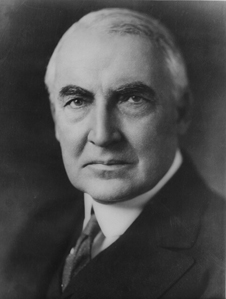
Warren Gamaliel Harding (November 2, 1865 - August 2, 1923) was the 29th (1921 - 1923) President of the United States and the sixth President to die in office.
Biography
Harding was born in Blooming Grove, Morrow County, Ohio, November 2, 1865 and graduated from Ohio Central College at Iberia. He was the first sitting Senator to be elected President. Before becoming a Senator, he was a newspaper publisher and Lieutenant Governor of Ohio.Harding was the oldest of six children; his boyhood heroes were Alexander Hamilton and Napoleon. His mother was a doctor.
Prior to being President of the United States, Harding served as Ohio State Senator (1899-1903), Lieutenant Governor of Ohio (1903-1905), and U.S. Senator (1915-1921). As U.S. Senator, he had a terrible attendance record, missing over 2/3s of the roll-call votes, including the vote to send the 19th Amendment ( Women's Suffrage ) to the States for ratification.
In 1889 (when he was 24) Harding suffered a nervous breakdown and spent several weeks in a sanitarium. Two years later he married Florence "Flossie" Mabel Kling DeWolfe, age 30, a divorcee with one son. Flossie was described as stubborn and old-fashioned. Five years older than he, she had pursued him persistently, until he reluctantly gave in. Her father opposed the marriage, warning her not to marry into "the black-blooded Harding family."
Theirs was an unhappy marriage. Harding neglected her and focused his attention on his poker buddies and other women. Still, Flossie's managerial skills helped them build his newspaper into a financial success. She was circulation manager, and ran the show.
Early in 1920, before being nominated by the Republican party, Flossie visited Madame Marcia, an expensive and well-known psychic in Washington. Madame Marcia predicted that Harding would become President, but that he would also die in office.
A relative unknown outside his own state, Harding was a compromise candidate, who won the Republican nomination due to the political machinations of his friends. Before receiving the nomination, he was asked whether there were any embarrassing episodes in his past that might be used against him. He had a very limited formal education, suffered from depression, had spent several years in a sanitarium, had a rocky relationship with his wife (whom he referred to as "the Duchess"), had a longstanding affair with the wife of an old friend, and was a drinker despite Prohibition. Though he answered no, each of these issues was raised by his opponents during his presidency.
In the 1920 election, Harding ran against James M. Cox, whose Vice Presidential candidate was Franklin Delano Roosevelt. The election was a referendum on whether to continue with the progressive work of the Woodrow Wilson administration or to go back to the laissez-faire approach of the William McKinley administration.
Harding ran on a promise to "return to normalcy," which reflected three trends of his time: a renewed isolationism, a resurgence of nativism, and a turning away from the government activism of the progressive era.
During the campaign, rumors were printed that Harding's great-great-grandfather was a West Indian black and that other blacks lurked in his family tree. In response, Harding's campaign manager said "No family in the state has a clearer, a more honorable record than the Hardings, a blue-eyed stock from New England and Pennsylvania, the finest pioneer blood."
Al Jolson campaigned for Harding.
Harding received 61% of the national vote and 404 electoral votes. Cox received 35% of the national vote and 127 electoral votes. Eugene V. Debs, campaigning from Federal prison, received 3% of the national vote.
As President, Harding played golf twice a week, and poker twice a week. Although as Senator of Ohio, he had voted for Prohibition, Harding kept the White House well stocked with bootleg liquor. He attended baseball games regularly.
Upon winning the election, he placed many of his old allies in prominent political positions. Known as the "Ohio Gang," few of them showed any real talent and some actually used their new powers to rob the government. Corruption was rampant throughout Harding's administration, though it is uncertain how much Harding actually knew about his friends' activities. One of the most famous scandals of the time was the Teapot Dome scandal, which shook the nation for many years after Harding's death. The scandal involved Secretary of the Interior Albert B. Fall , who was eventually convicted of renting public oil fields to private concerns in exchange for personal loans. In 1931 Fall became the first member of Cabinet to be sent to prison.
Thomas Miller, head of the Office of Alien Property, was convicted of accepting bribes. Jess Smith, personal aide to the Attorney General destroyed papers and then committed suicide . Charles Forbes, Director of the Veterans Bureau , skimmed profits, earned fat kickbacks, and ran alcohol and drugs. He was convicted of fraud and bribery , and drew a two-year sentence. Charles Cramer, an aide to Charles Forbes committed suicide.
No evidence to date suggests that Harding personally profited from these crimes. "My God, this is a hell of a job!" Harding said. "I have no trouble with my enemies, but my damn friends, they're the ones that keep me walking the floor nights."
Throughout his administration, Harding favored Big Business and did his utmost to undo the legacy of his predecessor Woodrow Wilson. The only prominent legacy of Harding's administration was a plan by Secretary of State Charles Evans Hughes in the wake of World War I to reach an international agreement limiting the size of navies.
In June of 1923, Harding set out on a cross-country Voyage of Understanding. His plan was to meet regular people and explain to them his policies. During this trip, he became the first President to visit Alaska . At the end of July, while traveling south from Alaska, Harding developed a bad case of food poisoning. Arriving at the Palace Hotel in San Francisco , he developed pneumonia. He died early in the morning on August 2, 1923. Doctors surmised that he had suffered a heart attack . But Mrs. Harding refused permission for an autopsy. Harding was succeeded by the Vice President, Calvin Coolidge.
During the White House funeral, alone by the casket, Mrs. Harding spoke for more than an hour into the face of her dead husband. 16 months later, Mrs. Harding died of kidney disease (which killed Wilson's first wife).
Interment was in Marion Cemetery, Marion, Ohio. He was reintered in the Harding Memorial Tomb.
A book from 1930 called The Strange Deaths of President Harding suggests that there were many with motives to murder the President, including his wife.
Not until 1963, when dozens of love letters were discovered by biographers, that Harding had a 15-year relationship with Carrie Fulton Phillips, wife of his longtime friend James Phillips. She was 10 years younger than Harding. By 1915, she began trying to sway Harding to leave his wife. When he refused, she left her husband and moved to Berlin with her daughter. However, World War I soon broke out, and Carrie moved back to the U.S. and the affair reignited. Harding was now a Senator of Ohio, and a vote was coming up regarding a declaration of war against Germany. Carrie threatened to go public with their affair if he voted for the declaration. Harding voted for the declaration of war, but Carrie did not reveal the scandal to the world.
When Harding won the Republican presidential nomination in 1920, the affair was still going on. In order to remove the potential for the scandal breaking, the Republican National Committee sent Carrie and her family on a trip to Japan, paid them over $20,000, and promised monthly payments thereafter.
Even while seeing Carrie Phillips, Harding was also having an affair with Nan Britton, a flapper who was 30 years younger than he. In January 1919 in his Senate office, they conceived Harding's only child, Elizabeth Ann Christian. Harding never met his daughter, but he paid large amounts of child support. Harding and Britton continued their affair while he was President, utilizing a closet adjacent to the Oval Office for privacy.
After Harding's death, Britton tried unsuccessfully to win money from Harding's estate to pay for his daughter's future. In 1927, Nan Britton published a book The President's Daughter, which told all.
Supreme Court appointments
- William Howard Taft - Chief Justice - 1921
- George Sutherland - 1922
- Pierce Butler - 1923
- Edward Terry Sanford - 1923
- Home>
- Presidents>
- Warren Harding