
- Home>
- Presidents>
- Ronald Reagan
Presidents of the United States
Ronald Reagan
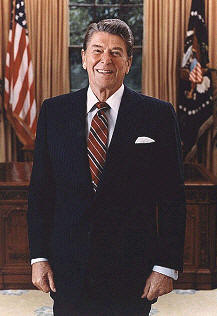
Ronald Wilson Reagan (February 6, 1911 – June 5, 2004) was the 40th (1981–1989) President of the United States and the 33rd (1967–1975) Governor of California. Reagan was also an actor in films before entering politics. He lived longer than any other President (93 years, 119 days) and was the oldest elected President (69 years, 349 days when taking office).
Early life and career
Reagan attended Eureka College in Eureka, Illinois, graduating in 1932. Child of an alcoholic father, Reagan developed an early gift for storytelling and acting. He was a radio announcer of Chicago Cubs games, getting only the bare outlines of the game from a ticker and relying on his imagination and storytelling gifts to flesh out the game. Once in 1934, during the ninth inning of a Cubs - St. Louis Cardinals game, the wire went dead. Reagan smoothly improvised a fictional play-by-play (in which hitters on both teams gained a superhuman ability to foul off pitches) until the wire was restored.
Film career
Reagan had a successful career in Hollywood as a
second-rank leading man, as his face and body were
as handsome as his voice. In 1940 he played the role
of George "The Gipper" Gipp in the film Knute Rockne
All American, from which he acquired the nickname
the Gipper, which he retained the rest of his life.
Reagan himself considered that his best acting work
was in Kings Row ( 1942 ). Other notable Reagan
films include Hellcats of the Navy and the campy
Bedtime for Bonzo. He has a star on the Hollywood
Walk of Fame at 6374 Hollywood Blvd.
Military service
Reagan was commissioned as a reserve cavalry officer
in the U.S. Army in 1935. After Pearl Harbor he was
activated and was assigned to the First Motion
Picture Unit in the Army Air Corps, which made
training and education films. He remained in
Hollywood for the duration of the war.
Television career
As
Reagan's film roles became fewer in the late 1950s,
he moved into television as a host and frequent
performer for General Electric Theater. His final
regular acting job was as host and performer on
Death Valley Days.
Early political career
Ronald Reagan began his political life as a liberal Democrat, supporting Franklin Delano Roosevelt and his New Deal. He gradually became a staunch social and fiscal conservative. He embarked upon the path that led him to a career in politics during his tenure as president of the Screen Actors Guild (SAG), aligning himself with Senator Joseph McCarthy and cooperating with the House Un-American Activities Committee to "expose Communist influence in Hollywood". He turned in several of his allegedly Communist co-workers, although unlike many anti-Communists of the time he was strongly opposed to the formal banning of the American Communist Party. His employment by the General Electric company, delivering anti-communist speeches on radio broadcasts and speaking tours, further enhanced his political image in the anti-Soviet climate of 1950s America. By the 1964 election, Reagan was an outspoken supporter of conservative Republican Barry Goldwater.In 1966, he was elected the 33rd Governor of California. Reagan tried to gain the Republican presidential nomination in 1968, and again in 1976 over the incumbent Gerald Ford but was defeated at the Republican Convention. He succeeded in gaining the Republican nomination in 1980. The campaign was marked by the Iran hostage crisis. Overseas press charged that the Reagan camp had made a secret deal to keep the hostages imprisoned until after the election. Most analysts believe President Jimmy Carter 's inability to solve the hostage crisis played a large role in his defeat and Reagan's victory. Reagan went on to be elected President that year and re-elected in a landslide in 1984.
Presidency
On March 30, 1981, just 69 days into his Presidency, while leaving the Hilton Hotel in Washington, DC President Reagan, Press Secretary James Brady, a Secret Service agent and a District of Columbia police officer were shot by a delusional John Hinckley, Jr. Shortly before surgery to remove the bullet from his chest (which barely missed his heart) he remarked to his surgeons, "I hope you're all Republicans," and to his wife Nancy he jokingly commented, "Honey, I forgot to duck."As a politician and as President, he portrayed himself as being:
- anti-communist
- in favor of tax cuts
- in favor of smaller non- military government
- in favor of removing regulations on corporations
- supportive of business interests, both large and small
- supportive of some individual liberties
- tough on crime
- increasing military spending
- deploying US Pershing II missiles in Germany in response to the Soviet stationing of SS-20 missiles near Europe
- pushing for the deployment of the Peacekeeper missile system
- negotiating nuclear arms reduction treaties
- proposing the Strategic Defense Initiative
- arming and training anti-communist groups like the Contras and the mujahideen
- selling arms to foreign allies such Taiwan , Israel , Saudi Arabia and, notoriously, Iraq
- lowering taxes significantly, reversing a historic trend towards higher taxes
- increasing the federal deficit
- greatly escalating the " war on drugs "
- ending the high inflation that damaged the economy under his predecessors, Jimmy Carter and Gerald Ford .
- helping to 'win' the Cold War
- firing air traffic controllers when they illegally struck
Reaganomics
Part of President Reagan's first term in office focused on reviving an inherited economy exhibiting stagflation, or both inflation and unemployment. Reagan's policies, partially based on supply-side economics sought to stimulate the economy with large across-the-board tax cuts. Most economists agree that tax cuts stimulate the economy, but supply-siders say that they have a much greater effect than most economists say they would. George H. W. Bush had called Reagan's economic ideas "voodoo economics" prior to becoming his vice-president. Reagan's policies soon became known as " Reaganomics ", a nickname used by both his supporters and detractors. These tax cuts combined with heavy military spending increases led to enormous deficit spending and a dramatic increase in the national debt. The debt increased by approximately 200% (tripled) between when Reagan took office and when his successor, George H. W. Bush, took office.On the other hand, this spending was slightly offset by increased tax revenues, and some supporters of Reagan attribute this to the successful use of supply-side economics tax policies. Critics of President Reagan argue that despite his frequent pronouncements that he advocated smaller and less intrusive government, federal spending and bureaucracy increased in size during his administration. Not surprisingly, there is disagreement over how much Reagan's policies contributed to the severe recession that took place in 1982, the strong economic expansion that began late in his first term and ran throughout his second term, and the fall in the average inflation-adjusted hourly wage for American workers that happened between his 1981 swearing-in and his successor's 1989 swearing-in.
The Soviet Union and the Cold War
Like many successful American politicians, Reagan had great stage presence, as well as great instincts for cultivating positive responses from the public. His calm speaking voice and forceful language earned him the nickname "the Great Communicator." On March 8, 1983 he called the Soviet Union an "Evil Empire" and later in his presidency while speaking in front of the Berlin Wall he challenged Soviet leader Mikhail Gorbachev to "tear down this wall". Some historians believe that all of those traits would have been meaningless without his perceived enthusiasm for America and strong personal belief in the individual.While many Reagan partisans credit him with winning the Cold War, scholars attribute the collapse of communism in 1989 in Eastern Europe and the Soviet Union to the mounting Soviet economic crisis and the failure of the economic and political reforms initiated by Soviet President Mikhail Gorbachev. Reagan's policies included strong support of the U.S. military and the doctrine of "peace through strength." One of his more controversial proposals was the Strategic Defense Initiative (SDI), a missile defense system which he hoped would make the U.S. invulnerable to nuclear missile attack by the Soviet Union. SDI was dubbed "Star Wars" by opponents, connoting the impractical or fantastic, and Reagan was given the nickname "Ronnie Raygun" by some wags.
Critics of SDI argued that the technological objective was unattainable in practical terms, and that the attempt would be likely to increase the Arms Race , as well as increasing the instability of future international crises. Other critics saw the extraordinary expenditures involved in the multiple distinct SDI programs as a military-industrial boondoggle.
Supporters call SDI the nail in the coffin of the arms race with the Soviet Union through the application the strategy of technology. They saw SDI as an attempt to convince the Soviets that their nuclear missile arsenal wwould become obsolescent, burdening the Soviets with addition spending on new technology to maintain a credible nuclear deterrent.
Reagan had a close friendship with many other conservative political leaders across the globe, especially Margaret Thatcher in Britain, and Brian Mulroney in Canada. Reagan had a great desire for establishing personal relationships with other heads of state, often inviting them to his ranch or Camp David for casual retreats.
As part of the policies that became known as the Reagan Doctrine, the United States also took an increasingly hard line against Communist influences in Latin America, which often involved the controversial support of anti-Communist military dictatorships with poor human rights records. This has led some to charge that Reagan was undertaking secret and illegal guerilla wars. In 1983 Reagan ordered a formal military invasion of the small island nation of Grenada after it underwent a Communist coup. Near the end of his term, Reagan was also instrumental in supporting the transition of Latin American democracy, giving generous foreign aid packages to states who held free elections.
Iran-Contra Affair
During his administration, there was a major scandal and investigation of his administration's covert support of wars in Iran and Nicaragua in what came to be known as the Iran-Contra Affair. Two members of administration, National Security Advisor John Poindexter and Col. Oliver North had hatched an elaborate plot to sell arms to the Iranian government and give the profits to the anti-Communist Contras guerillas in Nicaragua, who were engaged in a bloody civil war. Both actions were contrary to acts of Congress. Reagan professed ignorance of the plot, but admitted that he had supported the initial sale of arms to Iran, on the grounds that such sales were supposed to help secure the release of Americans being held hostage by the Iranian-backed Hezbollah terrorist group in Lebanon.Reagan's quick call for the appointment of an Independent Counsel to investigate the wider scandal, and cooperation with counsel, kept Iran-Contra from ending his presidency. It was found that the President was guilty of the scandal only in that his lax control of his own staff resulted in his ignorance of the arms sale. Although considered personally honest by most Americans, President Reagan and his term in office saw several other scandals of bribery, corruption, and influence peddling involving Reagan's aides and subordinates, resulting in more than 130 officials in the Reagan Administration either being convicted or forced to resign their posts to avoid prosecution. The failure of these scandals to damage Reagan's reputation led Congressman Patricia Schroeder to dub him the " Teflon President", a term that has been occasionally attached to later Presidents and their scandals.
"War on Drugs"
Reagan's policies in the " War on Drugs " emphasized imprisonment for drug offenders while cutting funding for addiction treatment. This resulted in a dramatic increase in the USA's prison population. Critics charged that the policies did little to actually reduce the availability of drugs or crime on the street while resulting in a great financial and human cost for American society. Nevertheless, it was an important part of Reagan's policy of being tough on crime. Due to this policy and various cuts in spending for social programs during his Presidency, Reagan was regarded by some critics as indifferent to the needs of poor and minority citizens.Miscellaneous
On August 5, 1981, Reagan fired 11,359 striking air traffic controllers who ignored his order to return to work. Ironically, PATCO , the air traffic controller's union, had been one of the few unions that had supported Reagan over Carter in the election nine months previous.In the spring of 1983, Reagan sent US Marines into Lebanon. Following several smaller bombings, a truck bombing of their barracks killed 241 Marines. Two days later Reagan invaded the tiny Caribbean nation of Grenada. Three months later, Reagan withdrew the Marines from Lebanon.
On July 13, 1985, Reagan underwent surgery to remove cancerous polyps from his colon, causing the first-ever invocation of the Acting President clause of the 25th Amendment. On January 5, 1987, Reagan underwent prostate surgery which caused further worries about his health.
Reagan was widely criticized in 1985 for an incident related to an official visit to West Germany. On April 11, the White House announced that Reagan would be visiting the Bitburg military cemetery, to lay a wreath in honor of German soldiers who died in both World Wars. This became controversial when it came to public attention that a small number (variously reported as 49 or 56) of gravesites contained remains of soldiers who had served in Waffen-SS units. Despite protests from various quarters, most notably Elie Wiesel, Reagan proceeded with the visit on the grounds that it would promote reconciliation between the former adversaries.
Legacy and retirement from public life
Reagan was in many ways the founder of the modern Republican Party. His redefinition of fiscal conservatism as being focused on tax cuts without significant regard to a balanced budget (" Reaganomics "); his opposition to progressive taxation, greater environmental protection and regulation, and abortion; the importance of the Moral Majority and its supporters in his governing coalition; and even his support of missile defense systems have all become trademarks of subsequent Republican leaders, including George W. Bush. Reagan's immediate predecessors such as Richard Nixon and Dwight Eisenhower would not have recognized any of these as part of the Republican platform.In 1992, four years after leaving office, Reagan was diagnosed with Alzheimer's disease. As the years went on, the disease began to slowly take over the former President's brain and body, forcing him to live his post-presidency in quiet isolation. He informed the nation of his condition himself when on November 5 , 1994 a letter he wrote was released announcing he had Alzheimer's disease. He can now no longer speak coherently and has trouble with even the most basic tasks. His health was further destabilized by a fall in 2001, which shattered part of his hip and rendered him virtually immobile.
On February 6, 1998, Washington National Airport in Washington, DC was renamed Ronald Reagan Washington National Airport. Also, the aircraft carrier USS Ronald Reagan (CVN-76) was christened March 4, 2001, making it one of the very few United States Navy ships to be named for a living person.
In November 2003, Reagan and his family were the subject of a controversial television miniseries, The Reagans. In response to the unflattering docu-drama, a number of Congressional Republicans introduced the "Ronald Reagan Dime Act" (HR 3633), a bill that would replace Franklin Delano Roosevelt 's portrait on the United States dime with Reagan's. The bill did not have widespread support and appeared unlikely to be put up for a vote. In 2004 , Reagan turned 93, making him the oldest former president in American history.
Death
Reagan died at his home in Bel Air, Los Angeles, California on June 5, 2004 at 1:09 PM local (Pacific) time. He died of pneumonia, with his wife Nancy and their children Patti and Ron present. He is survived also by his son Michael, from his first marriage to Wyman; his daughter Maureen preceded him in death in 2001.
Reagan was given a full presidential state funeral
on June 9, the first since Lyndon Johnson. With
4,000 people in attendance, Reagan's national
service at the National Cathedral on June 11
included eulogies by George W. Bush, George H. W.
Bush, Margaret Thatcher and Brian Mulroney. Numerous
other past and present world leaders attended the
service, including Mikhail Gorbachev. He was buried
that evening at sunset in a private ceremony, with
600 people in attendance, at the Ronald Reagan
Presidential Library in Simi Valley, California,
which included remarks from his three surviving
children.
Nancy Reagan lays her head on the flag draped casket
of President Reagan.Reagan holds the record for the
longest-living President in American history. John
Adams lived a record 90 years and 247 days before
Reagan surpassed it on October 11, 2001.
Quotes
- "This is the issue of this election: Whether we believe in our capacity for self-government or whether we abandon the American Revolution and confess that a little intellectual elite in a far-distant capital can plan our lives for us better than we can plan them ourselves.", nationwide televised speech supporting Barry Goldwater's presidential campaign, October 27, 1964.- "Mr. Gorbachev, tear down this wall!", speech at the Brandenburg Gate, Berlin, June 12, 1987.
- "Information is the oxygen of the modern age. It seeps through the walls topped by barbed wire, it wafts across the electrified borders. ... The Goliath of totalitarianism will be brought down by the David of the microchip."
- "What does an actor know about politics?", criticising Screen Actors Guild president Ed Asner for his views on foreign policy.
- "I know all the bad things that happened in that war. I was in uniform for four years myself," defending his visit to the Bitburg Military Cemetery.
- "My fellow Americans, I'm pleased to tell you today that I've signed legislation that will outlaw Russia forever. We begin bombing in five minutes," during a radio microphone test in 1984.
Supreme Court appointments
- Sandra Day O'Connor - 1981
- William Rehnquist - Chief Justice, 1986 (an associate justice since 1972)
- Antonin Scalia - 1986
- Anthony M. Kennedy - 1988
- Home>
- Presidents>
- Ronald Reagan