
- Home>
- Presidents>
- Lyndon Johnson
Presidents of the United States
Lyndon Johnson
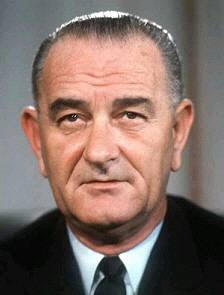
Lyndon Baines Johnson ( August 27, 1908 – January 22, 1973), often referred to as LBJ , was the thirty-sixth (1961 - 1963) Vice President and the thirty-seventh ( 1963 - 1969 ) President of the United States, succeeding to the office after the assassination of John F. Kennedy.
Early years
Lyndon Baines Johnson was born in Stonewall, Texas, on August 27, 1908. His parents owned a farm in a poor area and they could not provide their son with many advantages. He attended public schools throughout his childhood and graduated from Johnson City High School in 1924 .In 1927 Johnson enrolled in Southwest Texas State Teachers College. Even though he participated in debate and campus politics, edited the school newspaper, and spent a year away from his studies teaching school, Johnson somehow managed to graduate in only 312 days.
Soon after he graduated from college, Johnson taught public speaking and debate in a Houston high school. However, he soon quit his job teaching and went into the field of politics. Johnson's father had served five terms in the Texas legislature and was a close friend to one of Texas's rising political figures, Congressman Sam Rayburn. In 1931 Lyndon campaigned for Richard M. Kleberg and was later rewarded for his work in the campaign with an appointment to be the newly elected congressman's secretary.
As secretary, Lyndon became acquainted with people of influence, found out how they had reached their positions, and gained their respect for his abilities. Lyndon's friends soon included some of the men who worked around President Franklin D. Roosevelt, as well as fellow Texans such as Vice President John Nance Garner.
During his tenure as secretary, Johnson met Claudia Alta Taylor, a young woman who was also from Texas. After only a shortwhile of dating, the two were married on November 17, 1934. The couple later had two daughters, Lynda Bird, born in 1944, and Luci Baines, born in 1947.
In 1935, Johnson became the head of the Texas National Youth Administration. His new post enabled him to use the powers of government to find educational and job opportunities for young people. The position in effect enabled him to build political pull with his constituents. He served as the head for two years, only resigning to run for Congress.
Johnson received his first degree in Freemasonry on October 30, 1937. After receiving the degree he found that his congressional duties took so much time he was unable to pursue the masonic degrees.
Congressional years
In 1937 Lyndon campaigned successfully for the House of Representatives on a New Deal platform, effectively aided by his wife, Lady Bird Johnson.President Franklin Roosevelt showed a personal interest in the young Texan from the time he entered Congress. Johnson was immediately appointed to the Naval Affairs Committee , a job that carried high importance for a freshman congressman. In 1941, Johnson ran for the U.S. Senate in a special election, but he was defeated.
During World War II he served briefly in the Navy as a lieutenant commander, winning a Silver Star in the South Pacific. In 1948 , Lyndon again ran for the Senate and this time won. He was then appointed to the Armed Services Committee, and later in 1950, he helped create the Preparedness Investigating Subcommittee. Johnson eventually became its chairman and conducted a number of investigations of defense costs and efficiency. These investigations in result brought him national attention along with the respect of senior members of the Senate.
After only a few years in the Senate, Johnson was moving up in leadership power. In 1953, Lyndon was chosen by his fellow Democrats to be the minority leader. Thus, he became the youngest man ever named to the post by either major political party. In 1954, Johnson was re-elected to the Senate and since the Democrats won the majority in Senate, Johnson became majority leader. His duties were to schedule legislation and to help pass measures favored by the Democrats.
Vice Presidency
Johnson's success in the Senate led to his name being widely mentioned as a possible Democratic presidential candidate. He was Texas' "favorite son" candidate at the party's national convention in 1956. In 1960, Lyndon received 409 votes on the first and only ballot at the Democratic convention. However, the nomination eventually went to Senator John F. Kennedy of Massachusetts . Later in 1960, Kennedy nominated Johnson for vice president slot on the ticket. In November 1960 the Kennedy/Johnson duo beat out Richard M. Nixon and Henry Cabot Lodge, by a narrow margin.Upon swearing in, Kennedy appointed Johnson to head the President's Committee on Equal Employment Opportunities, which led him to work with blacks and other minorities. During his tenure as Vice President, Johnson also took on some international missions, which gave him limited insights into foreign problems.
Presidency
Johnson was sworn in as President on Air Force One due to the assassination of President Kennedy on November 22, 1963. Over the decades, many books and documentaries (including the 2003's The Men Who Killed Kennedy ) have come forth with considerations that LBJ was a co-conspirator behind the death of John F. Kennedy.In 1964, upon Johnson's request, Congress passed a tax-reduction law and the Economic Opportunity Act, which was in association with the War on Poverty.
In 1964, Johnson won the Presidency in his own right with 61 percent of the vote and had the widest popular margin in American history--more than 15,000,000 votes.
The Great Society program became Johnson's agenda for Congress in January 1965: aid to education, attack on disease, Medicare, urban renewal, beautification, conservation, development of depressed regions, a wide-scale fight against poverty, control and prevention of crime and delinquency, removal of obstacles to the right to vote. Congress, at times augmenting or amending, rapidly enacted Johnson's recommendations. Millions of elderly people found succor through the 1965 Medicare amendment to the Social Security Act.
Under Johnson, the country made spectacular
explorations of space in a program he had championed
since its start. When three astronauts successfully
orbited the moon in December 1968, Johnson
congratulated them: "You've taken ... all of us, all
over the world, into a new era. . . . "
Nevertheless, two overriding crises had been gaining
momentum since 1965. Despite the beginning of new
anti-poverty and anti-discrimination programs,
unrest and rioting in black ghettos troubled the
Nation. President Johnson steadily exerted his
influence against segregation and on behalf of law
and order, but there was no early solution.
The other crisis arose from Vietnam. Despite Johnson's efforts to end Communist aggression and achieve a settlement, fighting continued. Controversy over the war had become acute by the end of March 1968, when he limited the bombing of North Vietnam in order to initiate negotiations. At the same time, he startled the world by withdrawing as a candidate for re-election so that he might devote his full efforts, unimpeded by politics, to the quest for peace.
Vietnam War
He had a distaste for the American war effort in Vietnam, which he had inherited from John Kennedy. But Johnson believed that America could not afford to look weak in the eyes of the world, and so he escalated the war effort continuously from 1965 - 1968 , which resulted in thousands of American deaths and perhaps 60 times that number of deaths of Vietnamese (estimates range from 500,000 to 4,000,000). At the same time, Johnson was afraid that too much focus on Vietnam would distract attention from his Great Society programs, so the levels of military escalation, while significant, were never significant enough to make any real headway in the war. This approach was very unpopular with both The Pentagon and America's South Vietnamese allies. Against his wishes, Johnson's presidency was soon dominated by the Vietnam War . As more and more American soldiers died in Vietnam, Johnson's popularity declined, particularly in the face of student protests ("Hey, hey, LBJ, how many kids have you killed today?").Retirement
In March 1968 , in an address to the nation, Johnson announced that he would not seek renomination for the presidency, citing the growing division within the country over the war. The Democratic nomination eventually went to Johnson's Vice President Hubert Humphrey , who was later defeated in the 1968 election by Richard M. Nixon . After leaving the presidency in 1969 , Johnson went home to his ranch in Johnson City, Texas . Johnson died on January 22 , 1973 from a massive heart attack.Cabinet appointments
-
Secretary of
State
- Dean Rusk
-
Secretary of the
Treasury
- C. Douglas Dillon (1961-1965)
- Henry H. Fowler (1965-1968)
- Joseph W. Barr (1968-1969)
-
Secretary of
Defense
- Robert S. McNamara (1961-1968)
- Clark M. Clifford (1968-1969)
-
Attorney General
- Robert F. Kennedy (1961-1964)
- Nicholas deB. Katzenbach (1964-1966)
- Ramsey Clark (1967-1969)
-
Postmaster General
- John A. Gronouski (1963-1965)
- Lawrence F. O'Brien (1965-1968)
- W. Marvin Watson (1968-1969)
-
Secretary of the
Interior
- Stewart L. Udall
-
Secretary of
Agriculture
- Orville L. Freeman
-
Secretary of
Commerce
- Luther H. Hodges (1961-1965)
- John T. Connor (1965-1967)
- Alexander B. Trowbridge (1967-1968)
- Cyrus R. Smith (1968-1969)
-
Secretary of
Labor
- W. Willard Wirtz
-
Secretary of
Health, Education, and Welfare
- Anthony J. Celebrezze (1962-1965)
- John W. Gardner (1965-1968)
- Wilbur J. Cohen (1968-1969)
Supreme Court appointments
- Abe Fortas - 1965
- Thurgood Marshall - 1967
Johnson career documentary
Johnson is the subject of an extensive multi-volume biography: The Years of Lyndon Johnson by Robert A. Caro . So far three volumes have appeared:- Home>
- Presidents>
- Lyndon Johnson