
- Home>
- Presidents>
- George W. Bush
Presidents of the United States
George W. Bush
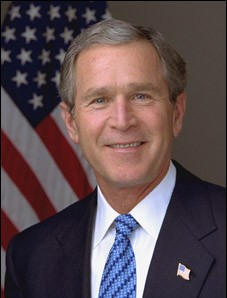
George Walker Bush (born July 6, 1946 ) is the 43rd and current President of the United States, succeeding Bill Clinton in 2001. His first term expires in 2005. He is currently seeking a second term, which would last till 2009, 2004 for a description of his campaign.
Bush was the 46th Governor of Texas from 1995 to 2000 and is a lifelong Republican.
Personal life and education
George W. Bush was born in New Haven, Connecticut and grew up in Midland and Houston, Texas. He has four younger siblings: Jeb, Neil, Marvin, and Dorothy. A younger sister, Robin, died of leukemia in 1953 at the age of three.Like his father, Bush was educated at Phillips Academy ( September , 1961 - June , 1964 ) and Yale University ( September, 1964 - May, 1968 .) While at Yale he joined Delta Kappa Epsilon (where he was president from October, 1965 until graduation), and the Skull and Bones Society. He played baseball during his freshman year and rugby during his junior and senior years. He received a bachelor's degree in history in 1968. Although he had an SAT score of 1206, 200 points below that of the average Yale freshman of 1970, he benefitted from an admissions policy which gave preference to the children of alumni (his score was at roughly the 70th percentile nationwide). He then earned a Master of Business Administration (MBA) from Harvard Business School, making him the first president to hold a MBA degree.
Bush married Laura Welch in 1977. In 1986, at age 40, he became a born-again Christian, converting from Episcopalian Christianity to his wife's denomination, Methodism. They have twin daughters, Barbara and Jenna, born in 1981. Barbara is currently a student at her father's alma mater, Yale University, while Jenna attends the University of Texas at Austin.
Bush is the second person to become U.S. President whose father was also President. ( John Adams, the second President, and John Quincy Adams, the sixth, were father and son.) Bush's father, George H. W. Bush , was the 41st President of the United States. There was also one grandfather-grandson pair, William Henry Harrison and Benjamin Harrison.
Controversies about early life
Bush had problems with alcohol for years after college, an issue on which he had been open, according to his spokeswoman Karen Hughes. He gave up drinking after his daughters were born, the day after his 40th birthday. CNN reported during the 2000 campaign that "at a campaign appearance at a charity center in San Jose, California, that helps people deal with addictions, Bush said, 'I was able to share with some of the men and women here that I quit drinking in 1986 and haven't had a drop since then.'"1976 arrest for DUI
When Bush was 30, he was arrested and fined for driving under the influence of alcohol (DUI), on September 4, 1976 in Kennebunkport, Maine. Bush was pulled over by police for driving too slowly near his family's Kennebunkport, Maine, summer home during the Labor Day weekend in 1976. Bush was driving with three passengers: his sister, Dorothy, tennis champion John Newcombe, and Newcombe's wife. After the arrest, Bush pleaded guilty to the misdemeanor DUI charge, paid a $150 fine, and had his driving privileges briefly revoked in the state of Maine. The charge was unearthed by Tom Connolly, a former Democratic candidate for Governor of Maine. Connolly said he received the information the Thursday before the 2000 election from an undisclosed Maine Democratic Party official. Connolly said he confirmed Bush's arrest by obtaining a copy of the court docket and gave it to a local television reporter, who was standing nearby. It then became an issue in the 2000 presidential election campaign five days before the vote.National Guard controversy
Whether Bush fulfilled his service to the Texas Air National Guard was also an issue that has dogged him in both his presidential campaigns.Business and political career
In 1978 Bush ran for the House of Representatives and was defeated by the Democratic State Senator Kent Hance.Bush began his career in the oil industry in 1979 when he began active operations of Arbusto Energy, an oil and gas exploration company he formed in 1977 with leftover funds from his education trust fund. The oil crisis of the late '70s hurt Arbusto Energy and, after a name change to Bush Exploration Co., Bush sold the company in 1984 to Spectrum 7, another Texas oil and gas exploration firm. Under the terms of the sale, Bush became CEO of Spectrum 7. History was repeated as the oil crisis of 1985-1986 bankrupted Spectrum 7. Spectrum 7 was subsequently saved by a buyout from Harken Energy Corp in 1986 with Bush becoming a director of Harken.
Bush was accused of using insider knowledge when selling stock while serving on the board of directors of Harken Energy Corp. in 1990 . After his sale of the stock, Harken reported a $23.2 million quarterly loss. An SEC investigation, alleged to be influenced by the fact Bush's father was President of the United States, declared "the investigation has been terminated as to the conduct of Mr. Bush, and that, at this time, no enforcement action is contemplated with respect to him." but noted that this did not mean that he was exonerated on that future charges might not brought. No further action has resulted, despite the fact that Bill Clinton, of the opposing political party, had been President for eight years between the administration of Bush and his father. As President, Bush has refused to authorize the SEC to release its full report on the investigation.
After working on his father's successful 1988 presidential campaign, he assembled a group of partners from his father's close friends and purchased the Texas Rangers baseball franchise in 1989. Critics of Bush allege improprieties in the venture, which earned $170 million, including tactics in acquiring both the team and the stadium and land it played on, as well as its later sale to a family friend who would donate money to the Bush campaign in 2000.
He served as managing general partner of the Rangers until he was elected Governor of Texas on November 8, 1994 over incumbent Ann Richards. When the team was sold in 1998, Bush had earned $15 million.
He went on to become the first Texas governor to be elected for two consecutive four-year terms. His tenure in office featured a positive reputation for bipartisan leadership.
Bush became President on January 20, 2001, as the winner of one of the closest general elections in American history - defeating Democratic Vice President Al Gore by only five electoral votes, while Gore won a plurality of the nationwide popular vote of more than 500,000 votes. The outcome was ultimately decided by only a few hundred popular votes in Florida, where Bush's brother Jeb was governor. (Until then, the most recent election in which a candidate lost the popular vote and won the election was in 1888 .)
The election results were hotly contested by Gore for several weeks until a U.S. Supreme Court ruling ended his efforts in mid-December. These election results are still contested by some, who claim Bush rigged the election.
Popularity
Following the September 11, 2001 Terrorist Attacks, President Bush enjoyed the highest approval ratings in history, upwards of 90 percent, according to most polls. High approval ratings are historically common for war-time Presidents, but Bush was able to maintain them for a year after the attacks. As of November 2002 , Bush had the highest approval rating of any President during a mid-term election since Dwight Eisenhower.In the 2002 mid-term elections, the Republican Party retook control of the U.S. Senate and added to their majority in the House of Representatives, bucking the historic trend. Historically, the party in the White House loses seats in the mid-term elections. It marked just the third time since the Civil War that the party in control of the White House gained seats in both houses of Congress in a mid-term election (others were 1902 and 1934). Some have suggested that the historic victory was due to Bush's popularity and his heavy campaigning for Republicans in numerous close races. However, others have argued that the Democrats lost seats in the election because of their timidity in criticizing Bush as a popular "war-time" President.
In 2003, Bush's approval ratings continued their slow descent from the 2001 highs. By late 2003, his approval numbers were in the low to middle 50s, around the lows of his Presidency. Nevertheless, his numbers were still historically solid for the third year of a Presidency, when the President's opponents typically begin their campaigns in earnest. Most polls tied the decline to growing concern over the U.S.-led occupation of Iraq and the economy's slow recovery from the 2001 recession. Late during the Democratic primary, most major polls showed Bush losing to the various Democratic challengers by a narrow margin.
Foreign policy and security
Bush's most significant foreign policy platform before coming to office involved support of a stronger economic and political relationship with Latin America, especially Mexico, and a reduction in involvement in "nation-building" and other small-scale military engagements.Bush's decision to impose a tariff on imported steel, and to withdraw from global initiatives such as the Kyoto Protocol, the ABM Treaty, and an international land mine treaty, has been argued as evidence that he and his administration have a policy of acting unilaterally in international affairs. The Bush administration, however, has in each case argued for the appropriateness of these policies. He has asserted, for example, that the Kyoto Protocol is "unfair and ineffective" because it would exempt 80 percent of the world and "cause serious harm to the U.S. economy", and that the ABM Treaty was a Cold War relic that left the US vulnerable to nuclear attacks by rogue states.
Many governments have criticized the failure of the United States to ratify the Kyoto protocol, which was signed by President Bill Clinton. Mr. Clinton recommended that his succesor (Mr. Bush) not submit the treaty for ratification until the wording was altered to reflect U.S. concerns. Bush, who is opposed to the treaty, removed U.S. executive approval from the proposed treaty. It is doubtful that the treaty would become law in the U.S. if it were submitted to the U.S. Senate for ratification as, in 1997, before the Kyoto Protocol was to be negotiated, the Senate passed by a 95-0 vote the Byrd-Hagel Resolution which stated that the United States should not be a signatory to any protocol that did not include binding targets and timetables for developing nations as well as industrialized ones or "would result in serious harm to the economy of the United States".
A change of focus immediately followed the September 11, 2001 attacks. His foreign (and domestic, to a lesser degree) policy was subsequently defined, above all, by the " War on Terrorism ". This was first described in a special "Address to a Joint Session of Congress and the American People" on September 20, 2001 in which Bush announced that America was fighting a war on terrorism.
In July, 2002, Bush cut off $34 million in funding for the United Nations Population Fund (UNFPA). This funding had been allocated by Congress the previous December. Bush claimed that the UNFPA supported forced abortions and sterilizations in mainland China. His justification came from a bipartisan group of anti-abortion members of Congress and an anti-abortion organization called The Population Research Institute, which claimed to have obtained first-hand video taped evidence from victims of forced abortion and forced sterilization in counties where the UNFPA operates in the PRC. The decision was praised by many in the pro-life movement, including the United States' largest public policy women's organization, Concerned Women For America.
Abortion-rights supporters criticized the decision and point out that the PRI refused to release information that would allow the team to locate the women, and thus no independent verification of PRI's claims was possible. Nor was it possible to confirm that UNFPA funding was actually behind the abortion and forced sterilizations alleged in the video. However, he sent a fact finding team to the PRC to investigate the situation there, and the team reported that UNFPA funding did not go towards forced abortions or sterilizations.
The Bush presidency has also been marked by diplomatic tensions with the People's Republic of China and North Korea, the latter of which admitted in 2003 to having been in the process of building nuclear weapons and threatened to use them if provoked by the US.
Bush has maintained a desire to resume the peace process in Israel, and openly proclaimed his desire for a Palestinian state to be created before 2005. He outlined a roadmap for peace in cooperation with Russia, the European Union, and the United Nations, which featured compromises that had to be made by both sides before Palestinian statehood could become a reality. One particular proposal was his instance for new Palestinian leadership; a stance that saw the appointment of the first ever Palestinian Prime Minister on April 29, 2003. The roadmap for peace stalled within months after more violence and the resignation of the new Palestinian Prime Minister, Mahmoud Abbas. By the end of 2003, neither side had done what was outlined in the plan.
Afghanistan
Once the source of the September 11 terrorist attacks was traced to Osama Bin Laden and his Al-Qaeda network operating out of Taliban -ruled Afghanistan, Bush launched a military campaign against the country. Though the original intent of the strikes was to destroy terrorist infrastructures and training camps, when the Taliban asked to see proof that bin Laden was behind the attacks the United States refused and instead threatened the Taliban with military action. The Taliban offered to extradite bin Laden to Pakistan, where he could be tried under Islamic law. But on November 13 , 2001 with the help of Afghan warlords, American troops seized control of the capital city, Kabul, and overthrew the Taliban government. Exiled President Burhanuddin Rabbani was returned to office, and was soon followed by a special interim government headed by former Afghani territorial governor Hamid Karzai. The government still has no means to control vast regions of the country, UN forces help to secure the area around Kabul and some other places but Osama Bin Laden still has not been found. Diplomatic relations between Afghanistan and the United States resumed, and Karzai became a close ally of Washington in the continued fight against terrorism.The Bush Administration has been criticized for holding several hundred individuals, including an undisclosed number of children. The great majority were captured in the combat zone in Afghanistan and accused of connections to Al-Qaeda or the Taliban, at Guantanamo Bay, Cuba without trial. Critics have stated that they must be treated as prisoners of war under the Geneva Convention. President Bush and his administration has disagreed, labelling the detainees as " unlawful combatants " who are not entitled to the protections of prisoners of war. Under article 118 of the Geneva Convention, prisoners of war "shall be released and repatriated without delay after the cessation of active hostilities." Under article 119, POWs "against whom criminal proceedings for an indictable offence are pending may be detained until the end of such proceedings, and, if necessary, until the completion of the punishment." Therefore, fair trials are needed in order not to violate the Geneva Convention, if the detainees have a valid claim to POW status. The Bush Administration and its supporters claim that the war against America by Al-Qaeda is ongoing, that it is unconventional, and that the "battlefield" extends into America itself. Critics question that people like Mullah Abdul Salam Zaeef , the former Taliban ambassador to Pakistan, who was crippled during the Soviet occupation, can be called "unlawful combatants" and claim that anyone accused for whatever crime has a right to a fair trial. The Bush Administration has never stated that it does not intend to give the accused a fair trial, and Bush has authorised military trials for the captives. As the detention camp begins its third year, the public still does not know who the detainees are, what they have allegedly done, and whether and when they will be charged with crimes or released. According to Human Rights Watch , as of January 2004, "the public still [did] not know who the detainees are, what they [had] allegedly done, and whether and when they will be charged with crimes or released. There [had] been no hearings to determine the legal status of detainees and no judicial review—in short, no legal process at all."
Critics of the Bush administration also point to the fact that the FBI did not follow the advice of Jesselyn Radack, a Justice Department ethics advisor, who advised that John Walker Lindh should be given access to his lawyer and should not be questioned without the lawyer present.
The experiences encountered in dealing with the Taliban government inspired a new attitude in the Bush Administration towards foreign policy. Bush asserted that in America's continuing war against terror, the United States should not differentiate between terrorist groups and the governments that support them. This view was highlighted in Bush's second State of the Union Address, in which he specifically singled out the nations of Iran , Iraq , and North Korea as particularly distressing examples of states that sponsor terrorism, dubbing them an Axis of Evil .
Iraq
By early 2002 Bush began publicly pressing for regime change in the nation of Iraq, indicating that his government had reason to believe that Iraqi President Saddam Hussein had ties to terrorist groups, was developing weapons of mass destruction and did not cooperate sufficiently with United Nations weapons inspectors. Although no agreement could be found with the United Nations Security Council, the war was ultimately launched in March 2003. Saddam Hussein was deposed and went into hiding on April 10, when Baghdad was captured. He was located and arrested in December. The occupation would ultimately prove difficult, with many Iraqis and foreigners launching attacks on American forces stationed in the country. Eventually, the US death toll in the post-war occupation eclipsed that of the actual war itself. Thousands of civilians were killed during the invasion and by terrorists.Controversy about Iraq policy
Throughout the course of the Iraqi war Bush was often the target of harsh criticism. Both in America and in the rest of the world there were numerous anti-war protests. On February 15 , 2003 there were over 10 million people in the streets all over the world. Critics also claimed that war is not a strategy that works to prevent terror but rather creates more violence and brings misery to whole countries rather than single out the "real culprits."Criticism also came from the governments of many countries, starting at the United Nations Security Council. Worldwide government positions on war on Iraq, The UN Security Council and the Iraq war. Critics claim that the UN did not authorize the Iraq war. Some claim that the UN even opposed the war, claiming that a withdrawn resolution would not have found a majority of support. The Bush Administration argues that resolutions such as the one that backed the Gulf War did authorize it. Critics who claim that war can only be authorized by the United Nations allege that the war broke international law.
For its part, the US administration soon presented a list of countries called the coalition of the willing.
Former United States Secretary of the Treasury Paul Henry O'Neill claims in a book that the administration had sought a reason to invade Iraq ever since Bush took office, with potential oil spoils charted in early documents. Rather than denying his allegations, Bush officials attacked his credibility, while answering that regime change in Iraq had been official U.S. policy since 1998, three years before Bush took office. However, O'Neill's claims called into question the relationship of the Iraq occupation to the post-9/11 War on Terrorism.
The inability of the U.S. to find weapons of mass destruction in Iraq, however, has led to greater domestic criticism of the administration's Iraq policy. Several of the statements that Bush and his administration made leading up to the war in Iraq, especially those involving claims of Iraqi weapons of mass destruction, have been criticized as misleading or inaccurate. Particularly controversial was Bush's claim in the 2003 State of the Union Address that British Intelligence had discovered that Iraq was seeking to buy uranium from Africa. Officials and diplomats disputed the evidence for this claim, especially after a document describing an attempted purchase from Niger, which was presented to the United Nations Security Council by Colin Powell, was found to be a forgery. This led to a public embarrassment for George Tenet, the director of the CIA, as well as the Valerie Plame scandal. Much of this criticism has come from political opponents of Bush; the Iraq war, and whether or not it was a good idea, has become a significant issue in the 2004 Democratic primary. This issue motivated much of the public support for the campaigns of Howard Dean and Dennis Kucinich .
In March 2004 former president Jimmy Carter roundly condemned George W. Bush and Tony Blair for waging an unnecessary war "based upon lies and misinterpretations" in order to oust Saddam Hussein . He claimed that Blair had allowed his better judgement to be swayed by Bush's desire to finish a war that his father had started.
Domestic security
Following the September 11 terrorist attacks the Bush administration asked Congress to approve a series of laws that it stated were necessary to prosecute the War on Terror. These included a wide variety of surveillance programs, some of which came under heavy fire from civil libertarians who criticized the Bush administration of scaling back civil liberties. On the other hand, the administration has been criticized for refusing to back security measures such as port security, allocating no money for it in 2003 and 2004, and vetoing all $39 million for the Container Security Initiative .Bush security initiatives
-
Through an act of Congress, the creation of a Department of Homeland Security (DHS), a cabinet -level agency designed to streamline and co-ordinate the various agents of federal government bureaucracy charged with protecting the American homeland from foreign attacks. (The White House had opposed the creation of this department for several months.)
-
A Total Information Awareness (TIA) program was proposed by the Defense Department . The TIA program did not receive funding from Congress, however, and is not currently operating. (Reports of similar program surfacing)
-
The USA PATRIOT Act which greatly expands the government's powers of surveillance and arrest. The act passed soon after September 11, 2001 .
-
Creation of the Foreign Intelligence Surveillance Court of Review which will review government acts of domestic spying .
-
" Project Lookout ", which distributes "watch lists" of people alleged to be suspicious, or have ties to terrorist groups to a variety of different organizations and institutions. These included specific "No-fly" lists of American residents who should not be allowed to board any aircraft into or out of the United States.
-
" Operation TIPS ", which would encouraged people who have access to American homes, like plumbers, to report suspicious activity. This proposal was rejected after an initial outcry.
-
The Worldwide Attack Matrix , an intelligence document describing covert operations abroad to defuse terrorist threats to American interests.
-
" NewRuleSets.project ", which provides a strategic framework for intervening in countries to move them into the "functioning core" of world societies and out of the "non-integrating gap" from which national security threats arise.
-
Creation of First Amendment Zones , where political protesters are allowed to exercise their free speech rights.
Some accused the Bush administration of using the threat of terrorism as an excuse to clamp down on political dissent; indeed, many of Bush's critics were quick to allege that they were being unfairly targeted by the new security measures. Defenders of the President's security policies have said that the continual criticism of his policies in both print and visual media shows there is no such crackdown, and point out that other presidents used legal means to stifle dissent during wartime as well.
Others accused the administration of over-reacting to the threat of terrorism, and participating in Big Brother style tactics with little justification. Critics of that view say that the prior administration under-reacted to the World Trade Center bombing on February 26, 1993, treating it as a criminal matter rather than an act of war.
Currently, a major controversy in the United States Congress is the debate over whether or not to expand the USA PATRIOT Act into a new Act known as USA PATRIOT Act II. This proposal would increase government surveillance on people in the United States suspected of terrorist activities and reduce judicial oversight over surveillance; authorize secret trials; and give the Justice Department the authority to revoke the American citizenship of anyone who belonged to an organization that the government deemed subversive. [13]
Supporters of the law cite the potentials of large-scale terrorism as justification that Americans need to shift their priorities more from civil liberties to security. Additionally, they point out that against earlier predictions, nearly two years have passed without a single terrorist act in the United States. Opponents allege that the new law enforcement powers have resulted in arrests of people who have not been publicly charged with anything, in violation of the U.S. Constitution and basic human rights.
In any event, the debate over the proper role of government in people's lives will continue. Ultimately, the U.S. Supreme Court and lower Federal courts may rule on the constitutionality of the new laws.
Cabinet and advisors
- Secretary of State - Colin Powell
- Secretary of Defense - Donald Rumsfeld
- Secretary of the Treasury - Paul O'Neill (2001-2003), John William Snow (2003-)
- Attorney General - John Ashcroft
- Secretary of the Interior - Gale Norton
- Secretary of Agriculture - Ann Veneman
- Secretary of Commerce - Donald Evans
- Secretary of Labor - Elaine Chao
- Secretary of Health and Human Services - Tommy Thompson
- Secretary of Housing and Urban Development - Mel Martinez (2001-2003)
- Secretary of Transportation - Norman Mineta
- Secretary of Energy - Spencer Abraham
- Secretary of Education - Roderick Paige
- Secretary of Veterans Affairs - Anthony J. Principi
- Secretary of Homeland Security - Tom Ridge (2003-)
- CIA Director - George Tenet
- FBI Director - Robert Mueller
- National Security Adviser - Condoleezza Rice
- EPA chair- Christine Todd Whitman (2001-2002)
- UN Ambassador- John Negroponte
- FCC Chairman- Michael Powell
- White House Chief of Staff - Andrew Card
- Republican party policy advisor- Karl Rove
- Counselor- Karen Hughes (2001-2002) ,
- NSC Office of Democracy, Human Rights, and International Operations- Elliot Abrams
- Office of Public Diplomacy director- Otto Reich
- Total Information Awareness Office director- John Poindexter (2001-2002)
Among the more criticized appointments have been John Negroponte, Elliot Abrams, Otto Reich, and John Poindexter for their roles in the Iran Contra Scandal and for covering up human rights abuses in Central and South America . Additionally, some appointments have been accused of being nepotism, including (in addition Michael Powell, son of Secretary of State Colin Powell): 28-year-old J. Strom Thurmond Jr (Sen. Strom Thurmond 's son) as South Carolina's US Attorney, Eugene Scalia (Supreme Court Justice Antonin Scalia 's son) as Solicitor for the Labor Department, Janet Rehnquist (Supreme Court Justice William Rehnquist 's daughter) as Inspector General of the Department of Health and Human Services (later fired for firearms charges and inappropriate job terminations), and Elizabeth Cheney (Dick Cheney's daughter) to the newly-created position Deputy Assistant Secretary of State for Near-East Affairs.
Legislation
Among Bush's most important legislation were several tax cuts, the No Child Left Behind Act, and the Medicare reforms. While Bush's supporters claim that the tax cuts increase the pace of economic recovery and job creation, his opponents accuse them to favor the wealthy and special interests and that Bush reversed a national surplus into a historic deficit. Of the $2.4 trillion budget for 2005 about $450 billion are planned to be spent on defense. Congress approved $87 billion for Iraq and Afghanistan in November, and had approved an earlier $79 billion package last spring. Most of those funds were for U.S. military operations in the two countries. No Child Left Behind targets supporting early learning, measures student performance, gives options over failing schools, and ensures more resources for schools. Critics state schools were not given the resources to help meet new standards. Concerning health care plans some claim that they still are not affordable for every American but Bush states his policies offered more choice and help with the high costs of health care and prescription drugs.Partial list:
- June 7 , 2001 : Economic Recovery and Tax Relief Reconciliation Act of 2001
- September 18 , 2001 : Authorization for Use of Military Force
- September 28 , 2001 : United States-Jordan Free Trade Area Implementation Act
- October 26 , 2001 : USA PATRIOT Act
- November 28 , 2001 : Internet Tax Nondiscrimination Act
- January 8 , 2002 : No Child Left Behind Act
- March 9 , 2002 : Job Creation and Worker Assistance Act of 2002
- March 27 , 2002 : Bipartisan Campaign Reform Act of 2002
- May 13 , 2002 : Farm Security and Rural Investment Act of 2002
- July 30 , 2002 : Sarbanes-Oxley Act of 2002
- October 16 , 2002 : Joint Resolution to Authorize the Use of United States Armed Forces Against Iraq
- November 25 , 2002 : Homeland Security Act of 2002
- March 11 , 2003 : Do-Not-Call Implementation Act
- April 30 , 2003 : PROTECT Act of 2003 [15]
- May 27 , 2003 : United States Leadership Against HIV/AIDS, Tuberculosis and Malaria Act of 2003
- May 28 , 2003 : Jobs and Growth Tax Relief Reconciliation Act of 2003
- September 3 , 2003 : United States-Chile Free Trade Agreement Implementation Act
- September 3 , 2003 : United States-Singapore Free Trade Agreement Implementation Act
- November 5 , 2003 : Partial-Birth Abortion Ban Act of 2003
- December 8 , 2003 : Medicare Prescription Drug, Improvement, and Modernization Act of 2003
- December 16 , 2003 : Controlling the Assault of Non-Solicited Pornography and Marketing Act (CAN-SPAM)
References
- Auletta, K. (2004, January 19). Fortress Bush: how the White House keeps the press under control. The New Yorker, LXXIX, 53.
- Home>
- Presidents>
- George W. Bush