
- Home>
- Presidents>
- Dwight Eisenhower
Presidents of the United States
Dwight Eisenhower
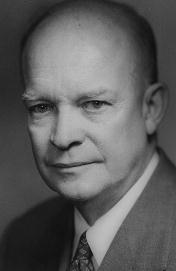
Dwight David Eisenhower ( October 14, 1890 - March 28, 1969 ) American soldier and politician, was the 34th President of the United States ( 1953 - 1961 ) and supreme commander of the Allied forces in Europe during World War II.
January 20 , 1961
Early life and family
Eisenhower was born in Denison, Texas, the third of David Jacob and Ida Elizabeth Stover Eisenhower's seven sons. The Eisenhower family was of German descent, but had lived in America since the 18th century. The family moved to Abilene, Kansas, in 1892. Eisenhower graduated from Abilene High School in 1909 and he worked at Belle Springs Creamery from 1909 to 1911.Eisenhower married Mamie Geneva Doud (1896-1979), of Denver, Colorado on July 1, 1916. They had two children, Doud Dwight Eisenhower (1917-1921), and John Sheldon Doud Eisenhower (born 1922). John Eisenhower served in the United States Army, then became an author and served as U.S. Ambassador to Belgium. One of John Eisenhower's sons, David Eisenhower, married Richard Nixon 's daughter Julie in 1968.
Military career
Eisenhower enrolled at the United States Military Academy, West Point, New York, in June, 1911 and graduated in 1915. He served with the infantry until 1918 at various camps in Texas and Georgia. He then served with the Tank Corps from 1918 to 1922 at Camp Meade, Maryland and other places. He was promoted to Captain in 1917 and Major in 1920. In 1922 he was assigned as executive officer to General Fox Conner in the Panama Canal Zone, where he served until 1924 . In 1925 and 1926 he attended the Command and General Staff School at Fort Leavenworth, Kansas, and then served as a battalion commander, at Fort Benning, Georgia, until 1927.During the late 1920s and early 1930s Eisenhower's career in the peacetime Army stagnated. He was assigned to the American Battle Monuments Commission, directed by General John Pershing, then to the Army War College in Washington, D.C., and then served as executive officer to General George V. Moseley, Assistant Secretary of War, from 1929 to 1933. He then served as chief military aide to General Douglas MacArthur, Army Chief of Staff, until 1935, when he accompanied MacArthur to the Philippines, where he served as assistant military advisor to the Philippine Government. He was promoted to Lieutenant Colonel in 1936.
Eisenhower returned to the U.S. in 1939 and held a series of staff positions in Washington, D.C., California, and Texas. In June 1941 was appointed Chief of Staff to General Walter Kreuger, Commander of the 3rd Army, at Fort Sam Houston, Texas. He was promoted to Brigadier-General in September 1941. Although his administrative abilities had been noticed, on the eve of the U.S. entry into World War II he had never held an active command and was far from being considered as a potential commander of major operations.
After the Japanese surprise attack on Pearl Harbor, Eisenhower was assigned to the General Staff in Washington, where he served until June 1942. He was appointed Deputy Chief in charge of Pacific Defenses under the Chief of of War Plans Division, General Leonard Gerow, and then succeeded Gerow as Chief of the War Plans Division. Then he was appointed Assistant Chief of Staff in charge of Operations Division under the Chief of Staff, General George C. Marshall. It was his close association with Marshall which finally brought Eisenhower to senior command positions. Marshall recognised his great organisational and administrative abilities.
Wartime commander
In June 1942 Eisenhower was designated Commanding General, European Theater, based in London. Here he planned and executed the Allied landings in Morocco and Algeria, codenamed Operation Torch. He was Commander-in-Chief of the Allied Forces in North Africa from November 1942. In December 1943 he was Appointed Supreme Commander, Allied Expeditionary Forces, charged with planning and carrying out the Allied invasion of France, Operation Overlord, in June 1944. He commanded all Allied forces in the Normandy invasion, which took place on D-Day, June 6, 1944. On December 20, he was promoted to General of the Army. By the end of 1944 Eisenhower was in overall command of armed forces comprising 4.5 million men and women.In these positions Eisenhower showed his great talents for leadership and diplomacy. Although he had never seen action himself, he won the respect of front-line commanders such as Omar Bradley and George Patton. He dealt skillfully with difficult allies such as Winston Churchill, Field Marshal Bernard Montgomery and General Charles de Gaulle. He had fundamental disagreements with Churchill and Montgomery over questions of strategy, but these rarely upset his relationships with them. He negotiated with Soviet commanders such as Marshall Zhukov, and sometimes directly with Stalin, such was the confidence that President Roosevelt had in him.
After the German surrender on May 8, 1945 , Eisenhower was appointed Military Governor of the U.S. Occupation Zone, based in Frankfurt-am-Main but soon delegated this position to Patton. He was named Chief of Staff of the U.S. Army in November 1945. In December 1950 he was named Supreme Commander of the North Atlantic Treaty Organization, and given operational command of NATO forces in Europe. Eisenhower retired from the Army in July 1952, on entering politics.
Eisenhower in politics
Eisenhower had been chosen as President of Columbia University in July 1948, giving him a legal residence in New York City. He had been mentioned as a possible presidential candidate since 1945. Unlike MacArthur, who had actively pursued the Republican presidential nomination since 1936, Eisenhower had shown little interest in politics. It was not even known if he was a Republican or a Democrat.Some writers have said that Democratic President Harry S. Truman offered to stand aside in favor of Eisenhower at the 1948 presidential election, although Truman always denied this. In the lead-up to the 1952 election, he was pursued as a candidate by both the Democrats and the Republicans. Eisenhower initially refused to run, but was eventually persuaded to allow his name to be put forward for the Republican nomination. He said he chose the Republicans because the Democrats had been in office for 20 years and the country needed a change. He defeated Senator Robert Taft of Ohio for the nomination.
In the lead-up to the presidential election, Eisenhower campaigned as a "non-politician," never mentioning his main competitor, Governor Adlai Stevenson of Illinois, by name. Instead he allowed other Republicans to run a Cold War campaign accusing the Democrats of being "soft on Communism" while he preserved his genial public image. For this reason he chose a hard-line, right-wing Senator from California, Richard Nixon, as his running mate. Eisenhower, as one of the country's two greatest war heroes, but with a much more congenial personality than MacArthur's, he was always likely to be elected. Eisenhower and Nixon won the November election with 442 electoral votes, against Stevenson's 89.
Eisenhower as President
Foreign affairs
Eisenhower's presidency was dominated by the Cold War, the prolonged confrontation with the Soviet Union which had begun during Truman's term of office. His Secretary of State, John Foster Dulles, led the fight against the Communist powers with great zeal, but despite the urgings of the right wing of the Republican Party, Eisenhower pursued a generally moderate course, accepting the doctrine of containment orginally developed by George Kennan. During his campaign Eisenhower had promised to end the stalemated Korean War, and a cease-fire was signed in July 1953 . He signed defense treaties with South Korea and the Republic of China, and formed an alliance anti-Communist Asian and Pacific countries, SEATO, to halt the spread of Communism in Asia.In 1956 Eisenhower strongly disapproved of the actions of Britain and France in sending troops to Egypt in the dispute over control of the Suez Canal. He used the economic power of the U.S. over its European allied to force them to back down and withdraw from Egypt. During his second term he became increasingly involved in Middle Eastern affairs, sending troops to Lebanon in 1957, and supporting the coup in Iran which restored Shah Mohammed Reza Pahlavi to power.
Under Eisenhower's presidency the U.S. became the world's first global nuclear power, and the world lived in fear of a Third World War involving nuclear weapons. But Eisenhower hoped that after the death of Stalin in 1953 it would be possible to come to an agreement with his successors and halt the nuclear arms race. Several attempts were made to hold a summit with the Soviet leaders, the last such attempt failing in 1960 when Nikita Khrushchev withdrew following the shooting down of a U2 spy plane over the Soviet Union.
Domestic affairs
Like most Republican presidents Eisenhower believed that a free enterprise economy should run itself and took little interest in domestic policy. Although his 1952 landslide gave the Republicans control of both houses of the Congress, the Democrats regained control in 1954, limiting his freedom of action on domestic policy. He forged a good relationship with Congressional leaders, particularly House Speaker Sam Rayburn.Eisenhower appointed a Cabinet full of businessmen and left them to run the country. He was happy for them to take the credit for domestic policy and allow him to concentrate on foreign affairs. On the two major issues of the 1950s, Communism and the civil rights for Black Americans, he was reluctant to exercise leadership unless forced to. In 1957, however, he sent federal troops to Little Rock, Arkansas after Governor Orval Faubus attempted to defy a Supreme Court ruling that ordered the desegregation of all public schools.
Eisenhower was also criticized for not taking a public stand against Senator Joseph McCarthy 's anti-communist campaigns, although he privately hated him for his attacks on his friend and World War II colleague, General George Marshall , who had been Secretary of State under Truman. He said privately "I just won't get down in the gutter with that man," but this was little comfort to the many people whose reputations were ruined by McCarthy's allegations of Communist conspiracies.
Eisenhower endorsed the United States Interstate Highway Act, in 1956. It was the largest public works program in United States history, providing a 41,000-mile highway system. Eisenhower had been impressed during the war with the German Autobahn system and also recalled his own involvement in a military convoy in 1919 that took 62 days to cross the United States. Another achievement was a 20% increase in family income during his presidency, which he was very proud of. He added a tenth cabinet position, creating the Department of Health, Education, and Welfare. He achieved a balanced budget in three of the years that he was President.
Eisenhower retained his popularity throughout his presidency. In 1956 he was re-elected by an even wider margin than in 1952, again defeating Stevenson and carrying such traditional Democratic states as Texas and Tennessee. But once he left office his reputation declined, and he was seen as having been a do-nothing President. This was partly because of the contrast between Eisenhower and his young activist successor, John F. Kennedy, but also due to his reluctance to support the civil rights movement or to stop McCarthyism were held against him during in the liberal climate of the 1960s and 1970s. In recent years Eisenhower's reputation has recovered. A recent poll of historians rated him number eleven among all the Presidents. Nevertheless, the judgement of some historians is that Eisenhower's greatest achievements were those of his wartime military commands.
Eisenhower had mixed feelings about his Vice President, Richard Nixon, and only reluctantly endorsed him as the Republican candidate at the 1960 Presidential election. Nixon campaigned against Kennedy on the great experience he had acquired in eight years as Vice President, but when Eisenhower was asked to name a decision Nixon had been responsible for in that time, he replied (intending a joke): "Give me a week and I might think of something." This was a severe blow to Nixon and he blamed Eisenhower for his narrow loss to Kennedy.
Although Eisenhower lived for most of the postwar years at Valley Forge, Pennsylvania, the Eisenhower Presidential Library is located in Abilene, Kansas, where he grew up. Eisenhower and his wife are buried in a small chapel there, called the Place of Meditation.
Supreme Court appointments
- Earl Warren - Chief Justice - 1953
- John Marshall Harlan - 1955
- William J. Brennan, Jr. - 1956
- Charles Evan Whittaker - 1957
- Potter Stewart - 1958
- Home>
- Presidents>
- Dwight Eisenhower